

HOA Rules for Bounce House Rentals: Complete Compliance Guide
Planning a bounce house rental for your child’s birthday party in an HOA community requires more than just calling a rental company. This guide breaks down approvals, insurance, placement rules, and common restrictions so you can avoid last-minute cancellations and fines.
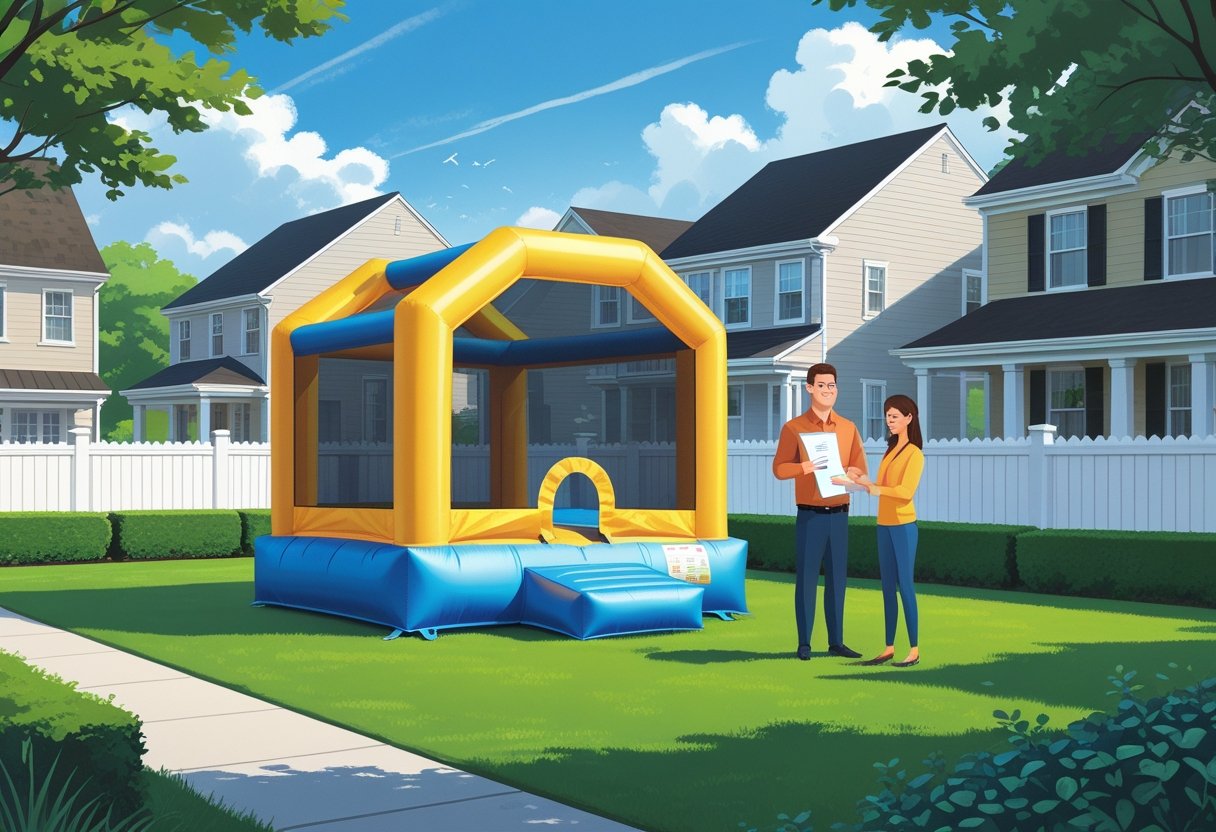
Key Takeaways
- HOAs can restrict or ban bounce houses through documented rules, architectural guidelines, and enforcement policies.
- Many associations require advance approval, proof of insurance, and signed liability/hold-harmless agreements.
- Knowing your community’s documentation requirements ahead of time helps you avoid fines and keeps your event stress-free.
FAQ
Can my HOA ban bounce houses even if it isn’t explicitly listed in the CC&Rs?
Sometimes—depending on your HOA’s governing documents and rulemaking authority. Many HOAs adopt additional rules under general nuisance, safety, or common-area policies.
What paperwork do HOAs usually ask for?
Common requests include an event application, vendor details, a Certificate of Insurance (COI), additional insured endorsement (sometimes), and a hold-harmless agreement.
HOA Rules for Bounce House Rentals: Complete Compliance Guide
Planning a bounce house rental for your child’s birthday party in an HOA community requires more than just calling a rental company. This guide breaks down approvals, insurance, placement rules, and common restrictions so you can avoid last-minute cancellations and fines.
Key Takeaways
- HOAs can restrict or ban bounce houses through documented rules, architectural guidelines, and enforcement policies.
- Many associations require advance approval, proof of insurance, and signed liability/hold-harmless agreements.
- Knowing your community’s documentation requirements ahead of time helps you avoid fines and keeps your event stress-free.
Understanding HOA Bounce House Rules
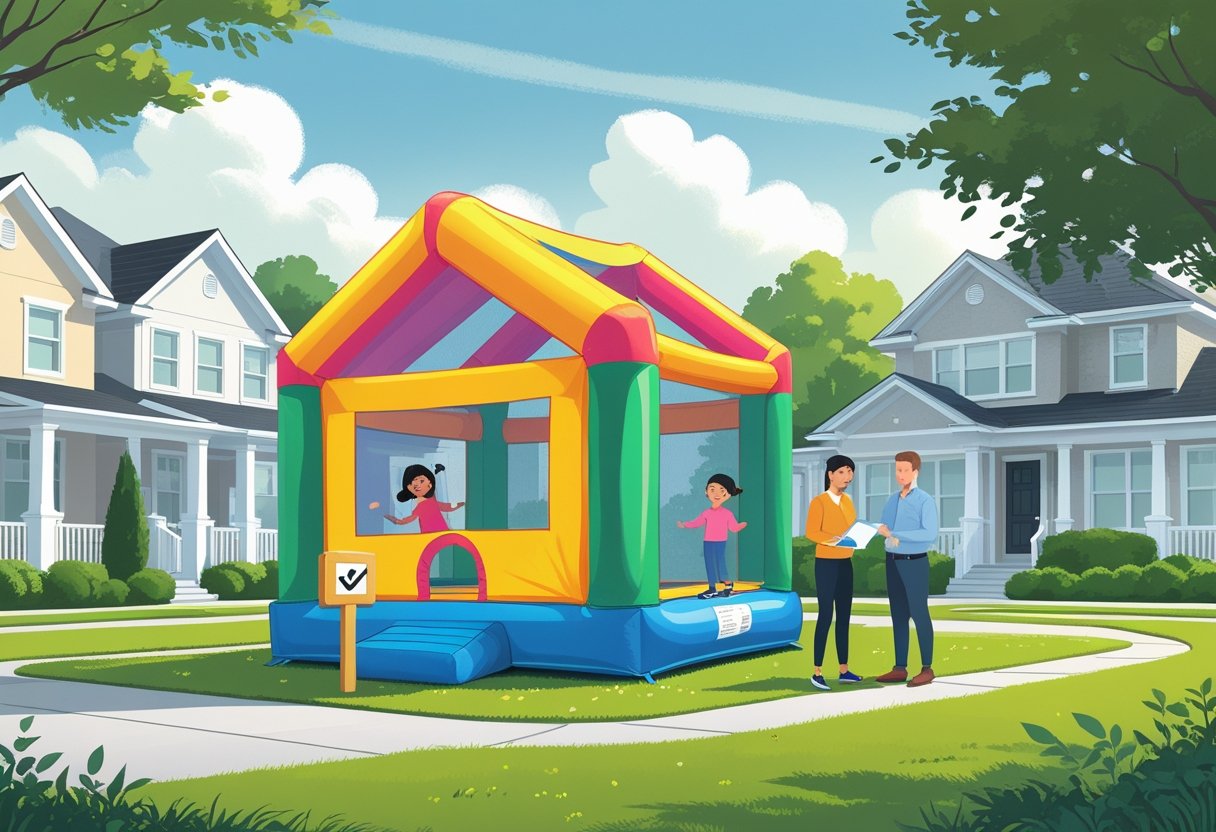
Homeowners associations often maintain guidelines that control where, when, and how inflatables can be set up. These rules are typically rooted in the HOA’s governing documents and are designed to balance personal enjoyment with safety, liability protection, and community standards.
Definition of Bounce House Rentals in HOAs
Bounce house rentals are temporary inflatable play structures used for events on HOA-managed property. Many associations classify these as temporary structures that may trigger architectural review requirements or special event approvals under the CC&Rs.
The definition often includes jump castles, moonwalks, inflatable slides, and combo units. Some HOAs distinguish between small residential units and larger commercial-grade inflatables based on size, height, or capacity.
Overview of Common Restrictions
Placement and Setup Requirements
- Backyard-only placement or restrictions away from common spaces
- Minimum distance from property lines, streets, sidewalks, and neighboring homes
- Limits near shared amenities (pool areas, playgrounds, greenways)
Time-Based Limitations
- Notice periods (commonly 48–72 hours; sometimes 7–30 days)
- Operating hours aligned with quiet hours
- Maximum rental duration (often 8–12 hours)
Safety and Liability Standards
- Proof of vendor insurance with minimum coverage amounts
- Requirement for the HOA to be listed as “additional insured”
- Inspection or permit processes for temporary structures
Importance of Compliance
Non-compliance can lead to fines that may accumulate until the violation is corrected. In some communities, unresolved violations can also trigger liens or legal action. Compliance also helps preserve good relationships with neighbors and the board.
Just as important: insurance and setup rules exist to reduce risk and protect you if an injury or property damage occurs during your event.
Rental Restrictions and Prohibitions
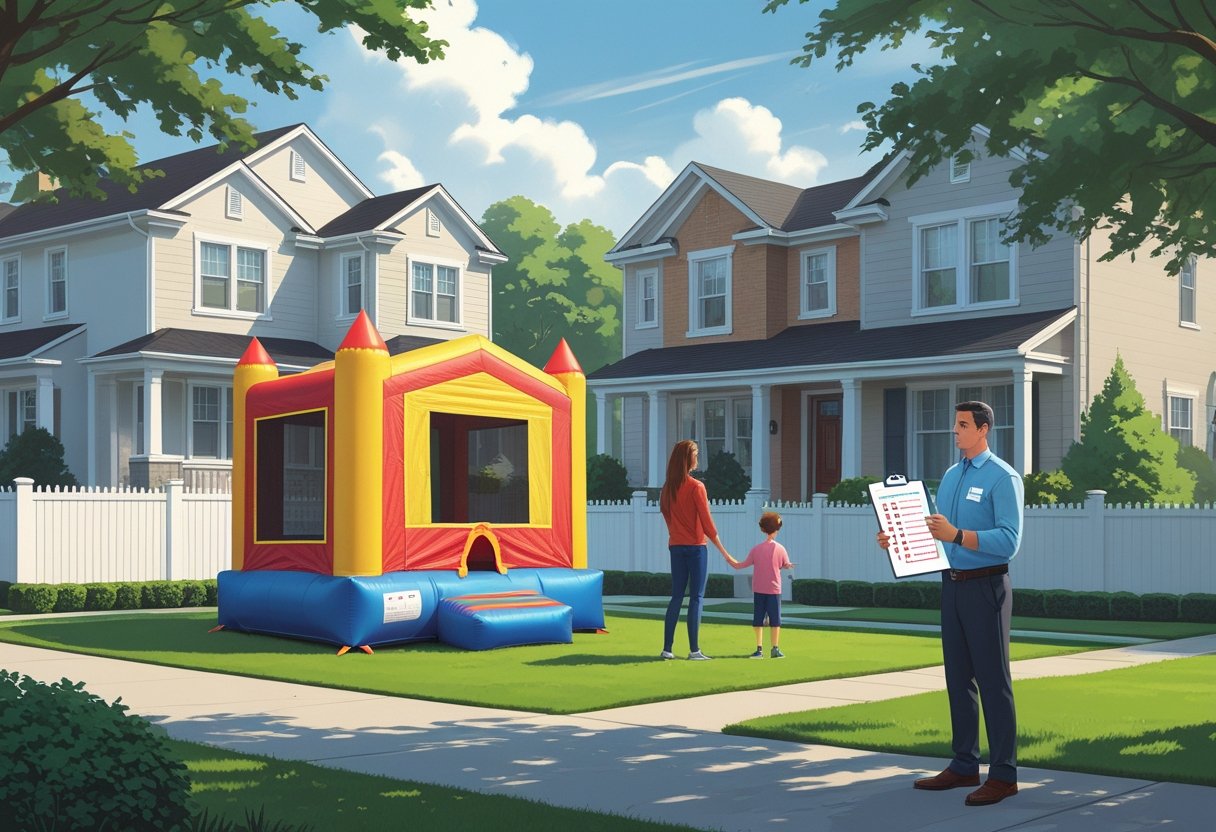
HOAs commonly implement restrictions through complete bans, usage caps, or strict time limits. These controls address neighborhood aesthetics, liability exposure, and day-to-day disruption.
Complete Bans on Bounce Houses
Some HOAs enforce blanket bans on inflatable rentals. If properly adopted within the governing documents or amended rules, these bans can be enforceable. Review your CC&Rs and any “temporary structures” or “nuisance” sections to confirm how your HOA treats inflatables.
Rental Caps and Permitted Usage
Many HOAs allow inflatables but limit frequency and duration, often requiring written approval for each event.
- Maximum number of rentals per year (often 1–4)
- Buffer periods between events
- Backyard-only placement
- Size limits based on lot dimensions
Short-Term Rental Restrictions
If the home is used as a short-term rental (Airbnb/VRBO), HOAs often apply stricter rules. HOAs may prohibit guests from using inflatables or require additional approvals beyond owner-occupied events.
Approval Processes and Documentation
Most HOAs require formal approval before setting up bounce houses—especially in front yards, visible areas, or common spaces. Expect an application, proof of insurance, and a board review process.
Application and Notification Requirements
Many associations require written notice 7–30 days in advance (some accept 48–72 hours). Include date, hours, duration, setup location, inflatable size, expected attendance, and vendor information.
- Event date and duration (often a 4–12 hour window)
- Exact setup location with measurements
- Vendor name, contact info, and (if requested) license details
- Expected number/ages of participants
- Type and size of inflatables
Insurance and Liability Documentation
HOAs commonly require evidence of liability coverage. Some require the HOA to be listed as an additional insured. Your homeowners policy may have liability coverage, but your HOA may require higher limits or a separate event policy.
Your rental company should provide a Certificate of Insurance (COI) showing adequate coverage for property damage and bodily injury.
HOA Board Review Procedures
Boards evaluate risk factors: proximity to common property, obstruction of sidewalks, noise impact, parking overflow, and safety supervision. Approvals may include conditions like adult supervision, capacity limits, and removal deadlines.
Many HOAs also require a signed hold-harmless / indemnification agreement. If denied, request the reason in writing and consider resubmitting with modifications.
Lease Terms and Event Duration Limits
Lease rules matter if you’re a tenant or if the property is used as a rental. Many HOAs limit rental terms to reduce short-term occupancy, and some treat party equipment differently for renters vs. owners.
Minimum Lease Period Requirements
- 30-day minimum (blocks nightly/weekly rentals)
- 6-month minimum (reduces seasonal/temporary housing)
- 12-month minimum (requires annual lease commitments)
These typically apply to occupancy agreements—not a homeowner hosting a party at their own primary residence. But if you’re a tenant, your landlord must usually comply with the HOA’s lease terms.
Time Limits for Bounce House Setup
Common restrictions include set-up/removal within specific hours and a strict removal deadline. Many HOAs prohibit leaving equipment overnight—even if deflated.
- Max event duration: 8–12 hours
- Mandatory removal by sunset or 9:00 PM
- Advance notice: 48–72 hours (or more)
Types of Bounce Houses and Permitted Units
HOAs often differentiate between basic bounce houses and larger specialty inflatables. The more visible, tall, loud, or water-intensive the unit is, the more likely it is to require special approval—or be prohibited.
Allowed and Prohibited Equipment
Basic residential bounce houses are more commonly allowed (often with backyard placement). Restrictions may include maximum dimensions, height limits, and visibility rules.
Commonly restricted: large commercial units, tall slides, obstacle courses, and any inflatable with water features due to drainage/runoff and noise concerns.
Combo Units and Specialty Attractions
Combo units (bounce + slide + extras) often face more scrutiny due to footprint and height. Specialty attractions like obstacle courses can run 30–50 feet long, raising boundary and aesthetic issues.
Many HOAs treat “wet” units (water features) differently than dry units—so confirm which you’re booking.
Community Events and Shared Spaces
HOA-sponsored events and common area rentals usually require more documentation and strict placement rules. Common areas introduce higher liability exposure for the association.
Guidelines for Community Event Rentals
For HOA-run events, the association typically coordinates the rental, verifies vendor credentials, and assigns supervision. Vendors may be required to provide COIs, inspection records, and safety certifications for equipment materials and setup.
Waivers and participant rules are common, and capacity/age limits must be enforced.
Rules for Using Common Areas
Using a green space, park, or other common area usually requires explicit written permission. Equipment cannot block walkways, fire lanes, or emergency access.
You may be responsible for any damage (grass, sprinklers, irrigation lines, pavement) and may be required to submit a refundable deposit.
Impact of HOA Rules on Residents
Protecting Property Values
HOA restrictions aim to preserve curb appeal and reduce liability exposure. Frequent or prolonged display of large inflatables can be viewed as visual clutter, which HOAs attempt to limit for perceived neighborhood consistency.
Balancing Fun and Community Standards
These rules can reduce spontaneity, but they often target practical issues: noise, parking congestion, safety, and boundary disputes. Planning ahead (documents, notice, and neighbor communication) is usually the difference between easy approval and a headache.
FAQ
Can my HOA ban bounce houses even if it isn’t explicitly listed in the CC&Rs?
Sometimes—depending on your HOA’s governing documents and rulemaking authority. Many HOAs adopt additional rules under general nuisance, safety, or common-area policies. Always review both CC&Rs and the latest rules & regulations.
What paperwork do HOAs usually ask for?
Common requests include an event application, vendor details, a Certificate of Insurance (COI), additional insured endorsement (sometimes), and a hold-harmless agreement signed by the homeowner/host.
Do I need extra insurance if I already have homeowners coverage?
Possibly. Your HOA may require higher limits than your policy provides or require the HOA to be listed as additional insured. Some homeowners policies won’t add additional insured endorsements, so you may need event coverage.
Can I put a bounce house in the front yard?
Many HOAs restrict front-yard placement due to visibility and aesthetic standards. Backyard placement is the most commonly allowed option when inflatables are permitted.
What’s the safest way to get HOA approval fast?
Submit a complete request: date/time, exact location, inflatable dimensions, vendor contact info, and COI. Send it early, follow up once, and proactively tell neighbors about party hours to reduce complaints.